
Jobs in Fashion - Historic Millinery Patterns with Lynn McMasters - Out of a Portrait Patterns
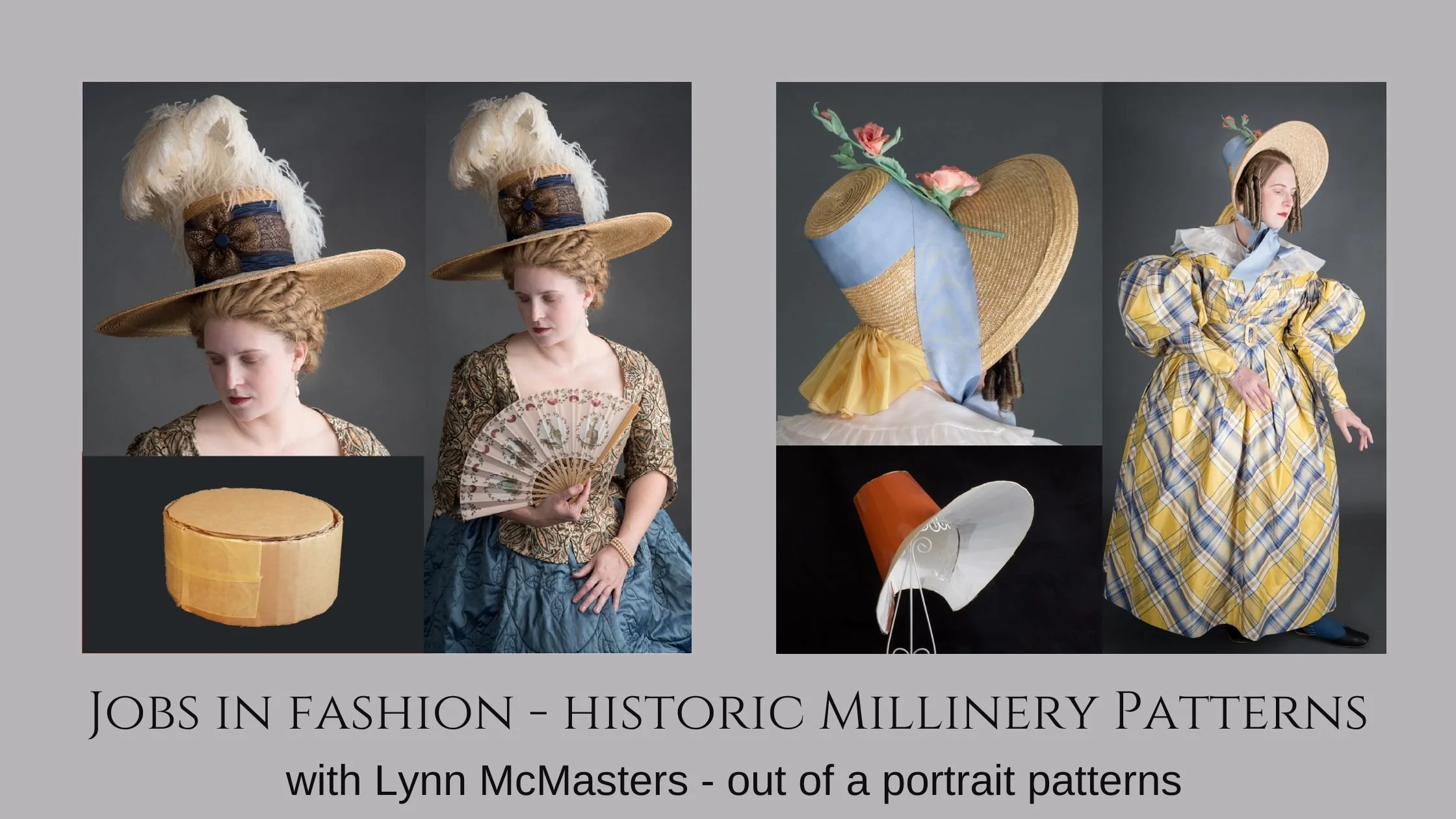
If you’ve been following @TheSewingRoomAlameda over on YouTube, you may have seen that we’ve interviewed a few Hat Makers of late. Each of the milliners have very unique products and make hats and head pieces in very different ways. While Lisa Jones (in the UK) concentrated on Bridal and Special occasion millinery, Sherry Hrycay focuses on more traditional hats likes blocked wool fedoras and straw braid hats.
In this interview let’s explore the work of Lynn McMasters who is a historic milliner who has been making patterns for hats since 2000. Lynn has over 65 patterns and many “how-to” posts on her website - www.OutOfaPortrait.com . In the US and Europe you can find her patterns at several other websites and from in-person resellers that sell historical patterns and supplies. Her other passions besides hats are fans, purses and feathers.
Please tell us a little bit about your background and how you started Out of a Portrait
Patterns.
I was taught to sew by my mom, Grandmother, and Aunt, and also my father taught me to use almost every tool in a wood shop. I learned my graphics skills on a MAC at the Marine Lab where I was the Graphic Artist - Scientific Illustrator. All these skills are important to what I do at …Out of a Portrait. The company started when I was in a Renaissance guild and making both hats and costumes for people. I realized early that I’m too slow to make money just making costumes on a per hour bases, so I had to find a better way. It seemed that there were enough patterns and books with patterns for clothing but nothing much for hats. I figured there might be a market for period hat patterns. I started with Medieval and Renaissance then ran out of hat styles and moved onto the 19th C which has so many I could never do them all. Although in the last few years I have done some 17th and 20th C hats. You might wonder at the name of my business, ….Out of a Portrait. I chose it because I think the greatest compliment that someone can give a person who is wearing a period costume is that “they look like they just stepped out of a portrait”.
Does your business support you and/or do you have other streams of Income?
No, I have never tried to make it a full-time job, just a decently paying part-time job.
Did you need to find investors to start your business?
No, I did need to buy a large format printer but already had a computer and the software and for the first few years my nephew hosted my website and helped me to create my website.
I see from your website that you sell hat patterns and Fan Kits.
Yes, I do have lots of patterns from many time periods and a few fan kits. The fan kits change over time.
Do you offer any bespoke or custom made services? if so, do people come to you or do you work remotely? both?
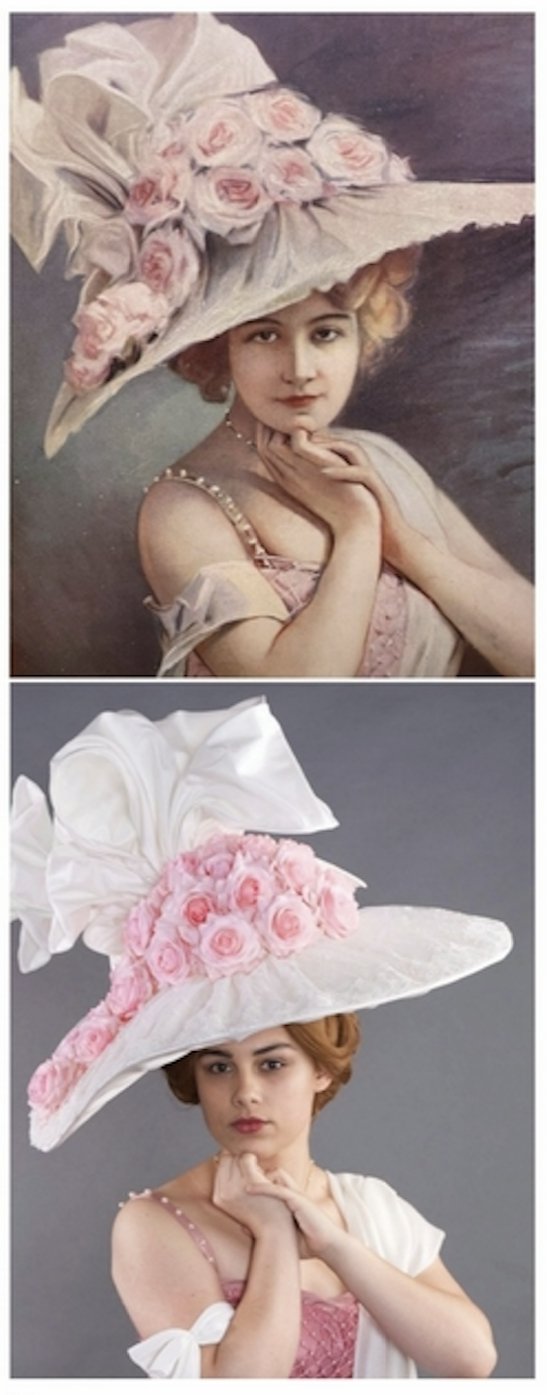
I rarely take orders but mostly I make hats and other accessories with the plan to either turn them into patterns eventually or for special photoshoots. Like this hat I made to reproduce a French Edwardian Hat Magazine cover (modeled by Breanna Bayba).
What kind of training have you had?
No real training as in an apprenticeship, but I did learn millinery from several professional milliners via taking classes.
I saw on your website (and have heard through the costuming grapevine) that you also teach workshops. How often do these happen & where?
Nowadays, I usually teach at least one to three workshop classes a year, mainly in the Bay Area at Lacis or with the GBACG, and often teach at their Costume Academy in March. Sometimes the classes are on Zoom, but I prefer in person.
Do you prefer working with individual clients or more with the DIY hat maker?
DIY hat makers for sure that is why I started ….Out of a Portrait, to create tools for them.
Do you do any hat blocking?
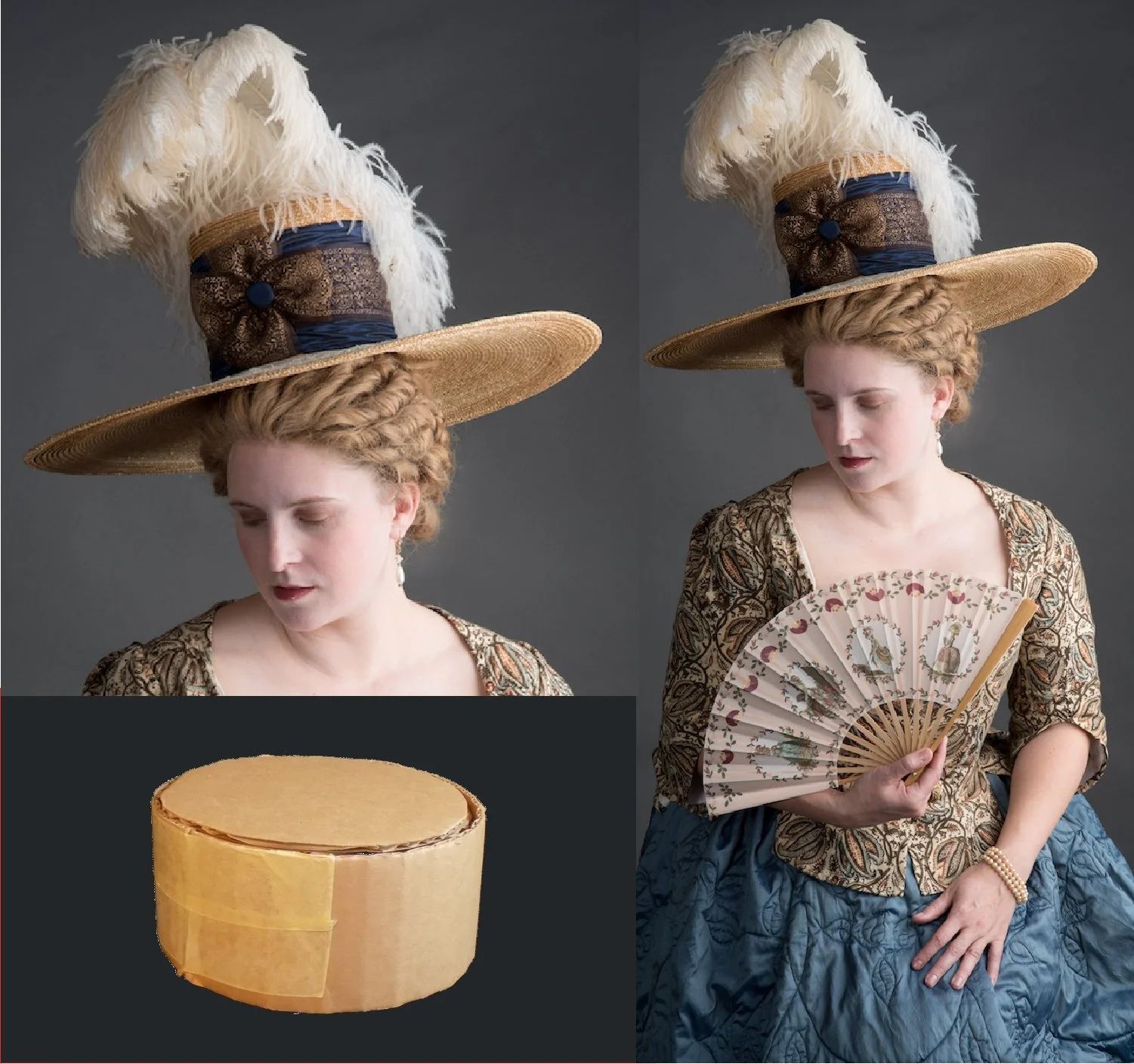
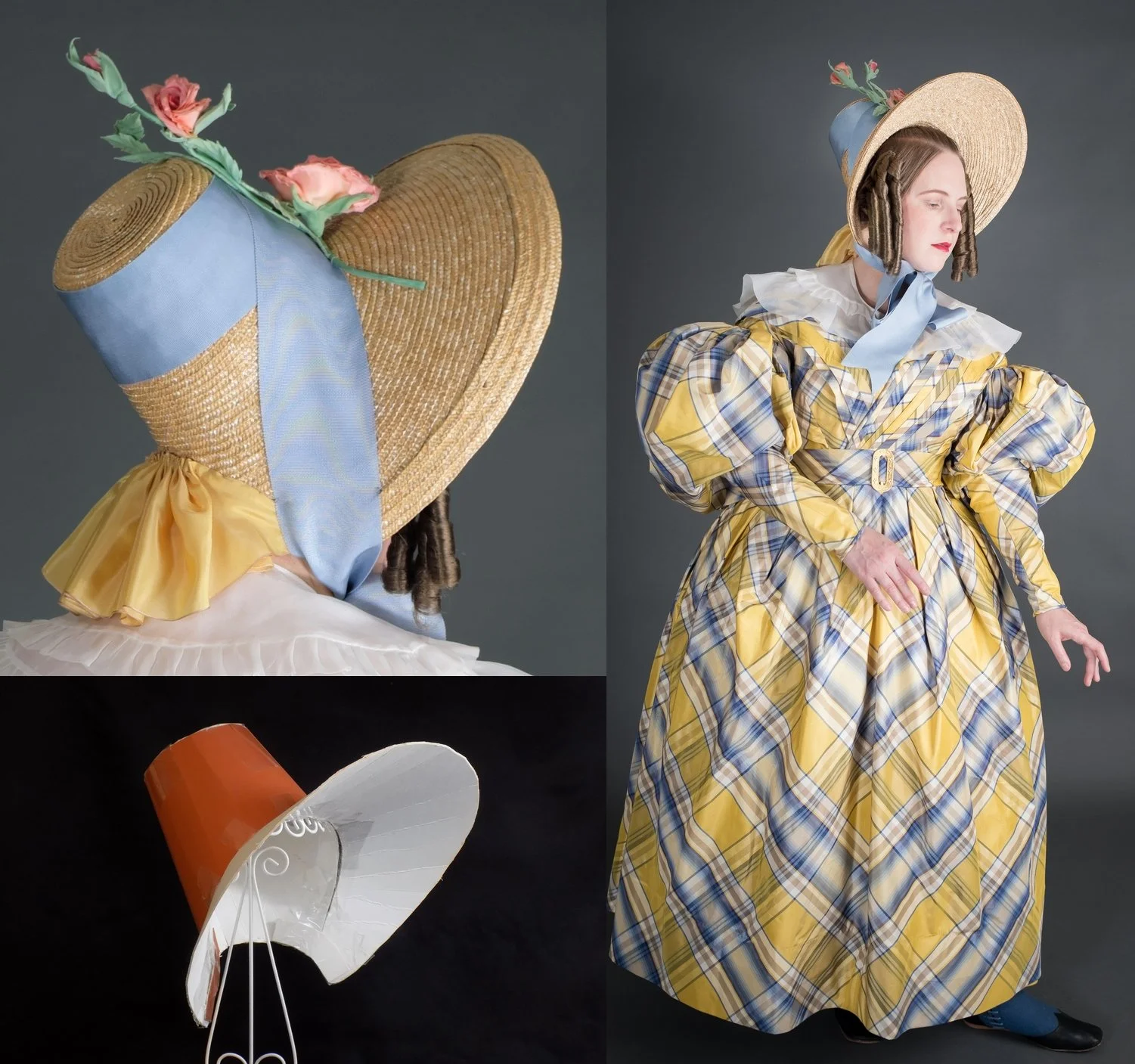
Oh, yes, I have blocked many hats but my favorite type of hat to block are sewn straw hats. I almost always make my own blocks out of cardboard. Many of my period patterns have instructions at the end for how to re-block a modern sunhat into period hat shapes. Most modern milliners block straw but it is a different type of straw and when done it does not look period correct because most women’s straw hats in the 18th and 19th C were made from sewn straw braid. So, I like to teach blocking sewn straw so students can see how simple and fast it can be compared to fabric covered buckram hats. Below two examples of blocked sewn straw hats (modeled by Laura Tavan).
How did you start making fans?
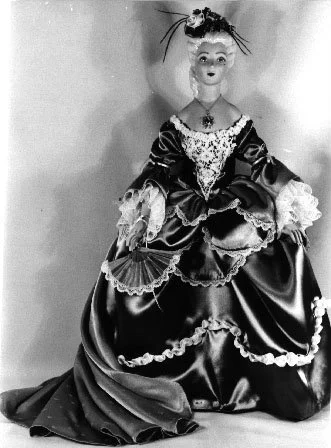
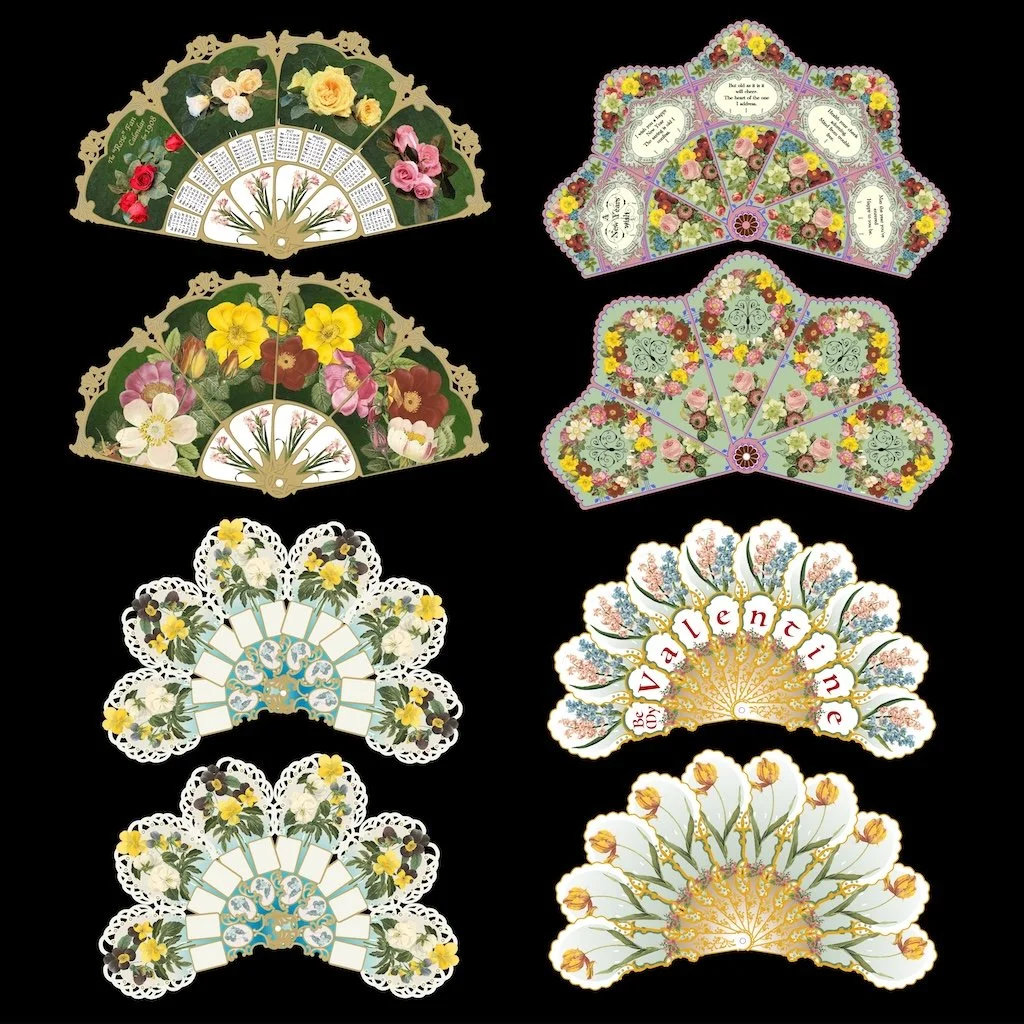
Silly enough it was for an 18th C costumed porcelain doll. Which was something I used to do early in my pattern drafting business days. But after the dolls I moved up to people sized costuming. About 8 years ago, I bought a set of 6 wrecked fans on Ebay with reviving them as the object. You can learn a lot studying wrecked fans, and two or three of the fans still had good sticks just the leaf was destroyed (usually it’s the silk that fractures). I found an article on drafting fan leaves and began using my drafting skills to do so. For a while I was selling folding fan kits but when my source of new good quality fan sticks ran out, I had to stop. But I did enjoy my time drafting period inspired fan leaves, printing them on stiffened silk and teaching fan making classes. Now I’m working to create kits for “early 20th century offset printed fans” which have no sticks just a rivet. I hope to start taking orders soon.
What is your favorite kind of headpiece to make?
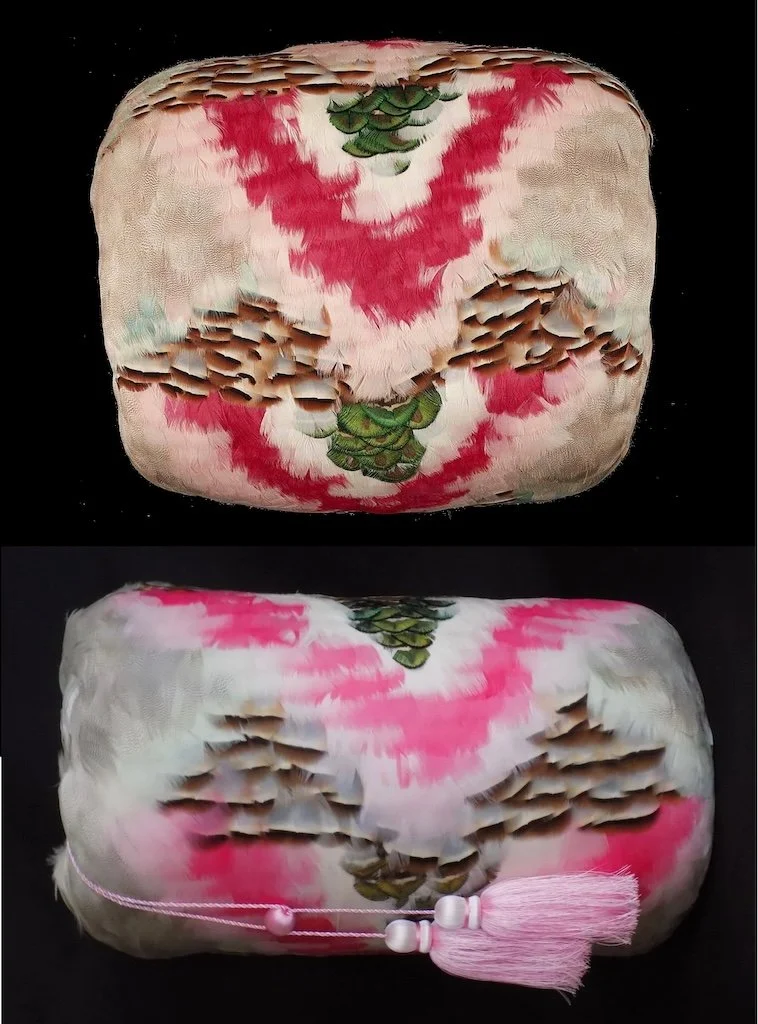
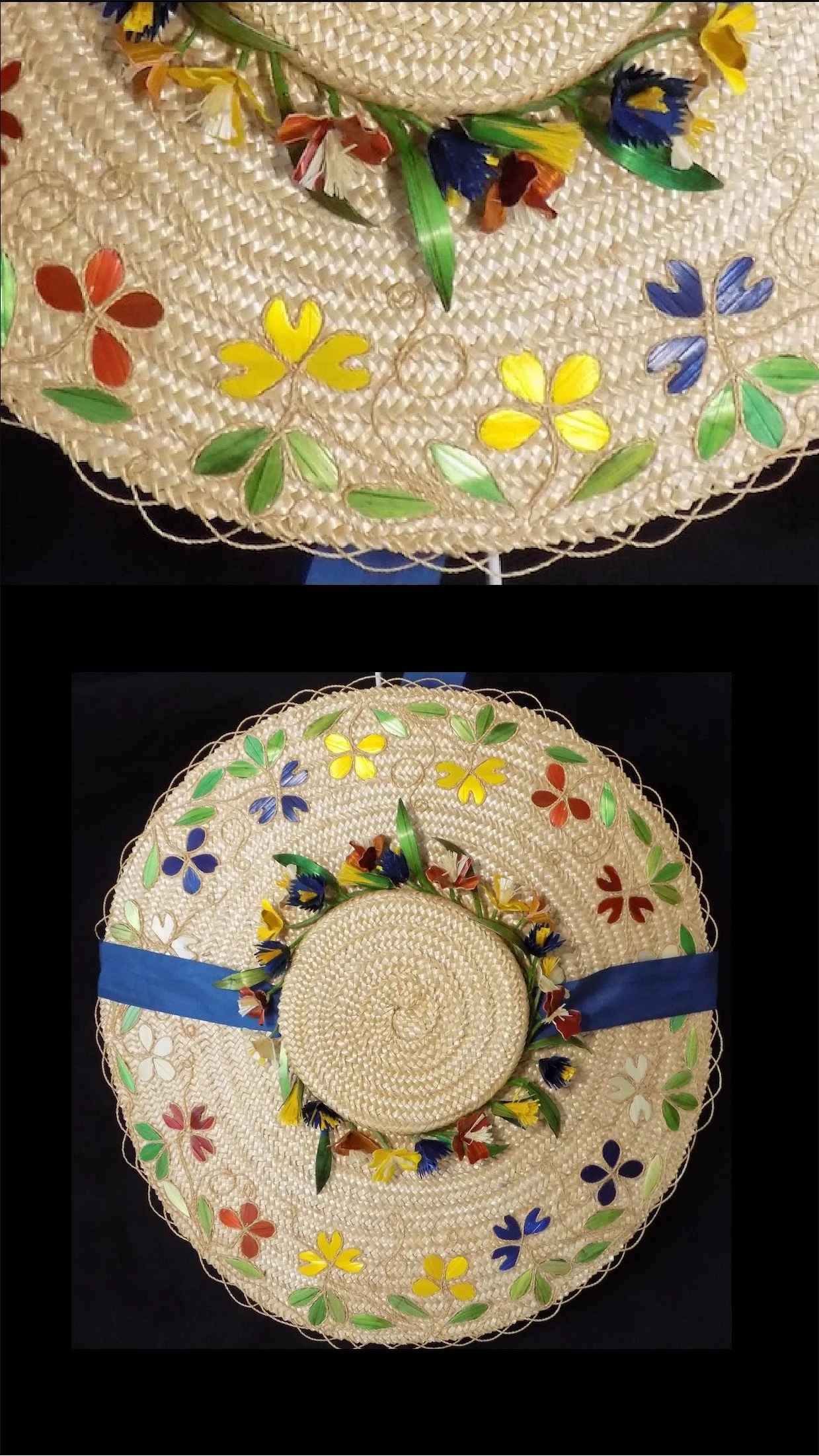
That would be as difficult as picking your favorite child! I will say that my favorite millinery experience is finding a fashion plate or museum picture of a type of hat or accessory that seems doable and is perhaps a little off what everyone else is doing but also iconic for the time period. Then, work to make something as close to that as possible. In other words, a challenge. Often it means working with unfamiliar materials like when I taught myself to do straw appliqué so I could do an 18th C bergère, or I learned how to sew feathers to fabric to make a 19th C feather muff.
Do you have any preferred materials?
No, not really, I might say straw plait, but in the last year I made hats with wireframes, felt and buckram. I do almost always use natural fabrics over the frames, mostly silk as far as materials go.
Who is your ideal client?
Someone who realizes how much time it takes to make one-of-a-kind things by hand as opposed to mass production.
What is the best way for people to connect with you?
Via my website… outofaportrait.com , which has my patterns along with lots of how to articles, Also, my Instagram , and my new Facebook page which I’m trying to build back (my old one was closed because as an early business page it did not have a connection to a personal page).
And finally, do you have any advice for beginning historic milliners just starting out?
Take some classes in construction. For period hats that might best be fabric covered buckram hats and hat blocking (felt or straw). Try making hats from period specific patterns. But most of all spend as much time as you can looking at extant hats and period fashion plates. If you can get your hands on antique and vintage hats that would be even better. You need to create a visual record in your mind (or on your computer) so when you make a hat you choose the right fabrics and decorations for that time period. As an example, hats are usually solid colors sometime a single-color jacquard, or a woven small check is an exception for some 18th C hats (drawn bonnets and calash). While ribbons can be striped and might every so often have embroidery. You are not going to see a bold plaid or print fabric covering a bonnet.
What you put on the outside of your hat can make or break it even if the shape is 100% correct and the technique is also perfect. Try to search out fashion plates, portraits or photos, often hats from two time periods can be the same shape but when you see them on a head you realize that in one case they might cover the full head in another they only sit on the top or back half of the head and one is twice the size of the other. This is really important if you are going to make a hat without a pattern.
Thank you Lynn! that was such a great interview. I love hearing about her process as well the story behind how Out of a Portrait Patterns came to life.
Until next time! Happy Fashion
xo Jennifer